Madeleine Nance from Kind Word shares how to stand out in the sea of corporate-sounding LinkedIn posts, so you can connect with the people who could fund your work.
What’s the first word that comes to mind when you think of LinkedIn?
When I ask this, a lot of people respond with things like…
“corporate”
“boring”
“scary”
Yes, I get it. Because I used to think that too.
LinkedIn can feel like a place where everyone’s just announcing promotions and posting jargon-filled business talk that makes your eyes glaze over.
But! What if I told you LinkedIn is actually one of the best places to connect emotionally with the people who could fund your work?
The opportunity hiding in plain sight
Here’s something that might surprise you:
- Around 40% of LinkedIn users are active on the platform every single day.
- But less than 1% of users post regularly.
That’s a lot of people scrolling. And not many people posting.
Because most people are “lurkers” – meaning they log in for a look at what’s going on, but they have no interest in posting.
For nonprofits trying to get in front of potential donors, grant funders, and corporate partners, this is a HUGE opportunity.
These people are already on LinkedIn. They’re already scrolling. The question is: are they seeing you?
And more importantly, when they do see you pop up on their feed, are they thinking, Wow, I need to know more about this? Or… are they scrolling right past?
The problem with “professional” content
Most nonprofit LinkedIn posts sound like this:
“We’re pleased to announce our Q3 results…”
It’s very polished and professional. It’s also completely forgettable.
Now imagine scrolling past this instead:
“I recently met a wonderful donor who told me…”
See how the vibe is totally different. The second one feels like a real person is talking. It opens with a moment and makes you want to click “see more” to know what happened next.
This is the shift I urge you to try: from professional updates to personal storytelling.
Because remember, your audience is made up of real people who have hearts and minds.
They want to feel connected to the work you’re doing. They want to peek behind the curtain and see what it’s really like inside your organization.
Why emotion matters more than ever
With the rise of AI-generated content flooding every platform, your biggest advantage is to make people FEEL something.
Yes, AI can write a perfectly polished LinkedIn post. It can hit all the right keywords and follow all the best practices.
But only you can share a specific moment from your own experience that made you laugh, or the thing someone said that brought tears to your eyes, or the frustration you felt when something went wrong.
Those are human emotions. And they are key to standing out.
That’s where emotive content comes in.
Five ways to make people feel something
When I think about emotive LinkedIn content, I think about five emotional responses you can aim for.
You could post something that makes people:
- Smile – Give them a glimpse into your day-to-day work. People love seeing what really goes on behind the scenes.
- Cry – Share a moment of transformation or hope. (I’m talking happy tears!)
- Shout – Tell them when something goes wrong. It sounds counterintuitive, but sharing challenges makes donors feel like insiders.
- Think – Offer your perspective on something in your field. LinkedIn loves thought leadership, and you have expertise worth sharing.
- Ask – Invite people into a conversation. Position yourself as someone who can answer their questions.
Each of these creates a different kind of connection. And when you rotate through them, you build a LinkedIn presence that feels dynamic and real, not “same-old” and robotic.
Your LinkedIn posts are an opportunity to deepen relationships with your supporters.
Each post can be a “micro-connection” that emotionally resonates with people… and makes them excited to know more about what you do.
Okay but what does this look like in practice?
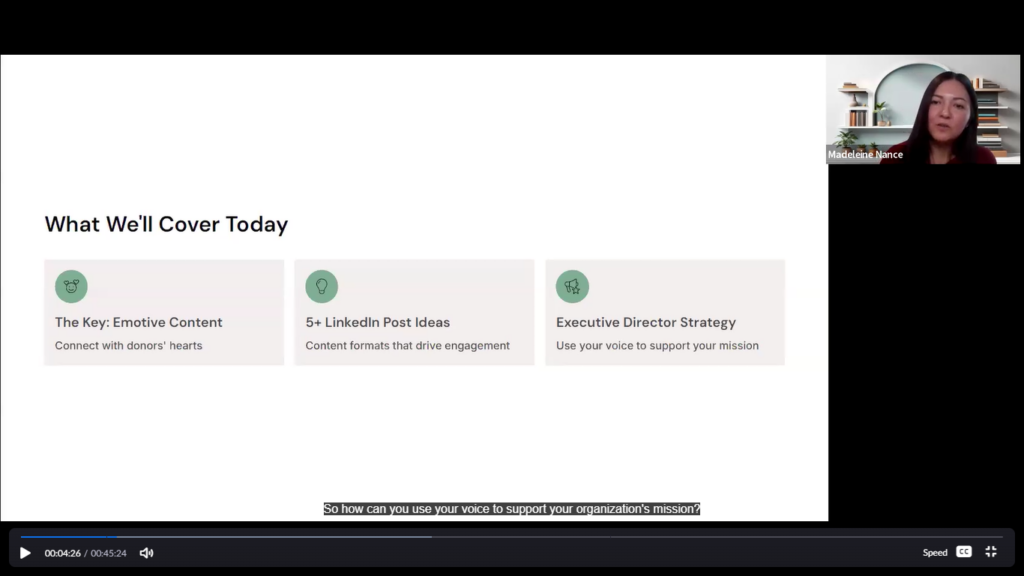
I recently presented a Tech Trends for Nonprofits webinar here at Nonprofit-Apps called LinkedIn 101 for Busy Nonprofit Professionals, where I walked through these ideas in more detail – including word-for-word examples of what each type of post looks like in action.
Author Bio:
Madeleine Nance specializes in emotive messaging — a fundraising approach that helps nonprofits move beyond sounding like every other organization to create donor communications that emotionally connect. Through her course Emotive Writing to Move Your Donor’s Heart and copywriting for organizations globally, she trains nonprofit teams to write in ways that touch hearts and inspire action, whether in emails, direct mail, or social media.