Nonprofits are under more pressure than ever to earn donor attention.
Supporters are being asked to give across countless campaigns, causes, and organizations, often through digital experiences that feel nearly identical. How many individual fundraisers and group fundraisers do you see come across your Facebook feed? Probably quite a few, right?
A donation form, a short paragraph about the mission, a few preset giving amounts, and a button to submit. It works right? That is part of the problem.
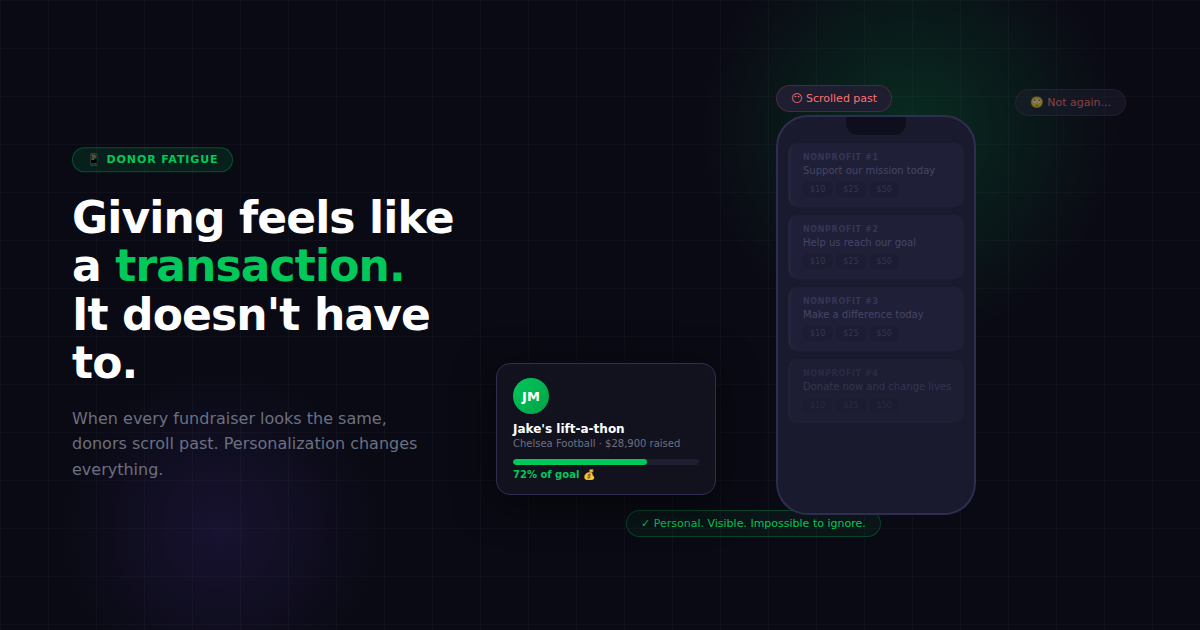
Most donation pages today ask for support, but do not create a reason to care. They present giving as a transaction rather than an experience. And when every fundraising campaign feels interchangeable, donor fatigue becomes inevitable. At least when kids were going door-to-door selling chocolate bars, that’s something that’s hard to ignore. Support the kid. That’s why fundraising platforms like Teamfi have to give organizations and non-profits the tools they need to succeed.
Stronger fundraising performance does not come from asking more often. It comes from creating campaigns that feel more personal, more visible, and more connected to a real outcome. When donors can see who they are helping, what their contribution is doing, and how their participation fits into a larger goal, engagement changes.
That shift toward personalization is helping nonprofits raise more, deepen connection, and create fundraising experiences that people actually want to take part in.
Generic fundraising is losing effectiveness
Traditional digital fundraising often relies on broad messaging. A donor lands on a page, reads a few lines about the organization, and is asked to contribute. In many cases, that approach still works well enough to generate some support. But it often leaves meaningful engagement on the table.
The challenge is not that donors have stopped caring. It is that many campaigns fail to create specificity.
A general appeal may explain that funds are needed, but it does not always help the donor feel personally connected to the need. It may describe the organization’s mission, but it does not always show the real-world impact of one contribution. It may ask for support, but it does not build momentum or emotional investment in the act of giving itself.
That is where many organizations begin to lose people.
When fundraising feels generic, it becomes easy to ignore. When it feels personal, it becomes much harder to dismiss.
This is especially important in an environment where nonprofits compete not only with one another, but with every other digital request for attention. A donation appeal is no longer judged only against similar fundraising campaigns. It is judged against the entire online experience a donor encounters every day. That raises the bar.
Personalization changes donor behavior
The most effective fundraising campaigns increasingly share one characteristic: they make the donor feel closer to the outcome.
That can take different forms. Sometimes it looks like an individual fundraising page tied to a student, athlete, participant, or advocate. Sometimes it means a named campaign goal with clear milestones. Sometimes it is progress tracking that shows a campaign advancing in real time. Sometimes it is a story centered on one person, one project, or one concrete result rather than an abstract organizational need.
The underlying psychology is consistent. People typically give to people, not organizations. Think of a grandmother supporting her grandson’s high school baseball team. She cares about the team primarily because her grandson is on it. Even a random stranger buying Girl Scout cookies. You don’t buy the cookies primarily because it supports the girl scouts, you do it because it makes the girl happy, and maybe because you want cookies.
That does not mean mission and brand no longer matter. They do. But in practice, donors are often moved to act when a cause can leverage the individual relationships that make people feel good. A student raising funds for a team trip. A participant working toward a community goal. A family directly impacted by a program. A campaign with a visible finish line and a clear purpose.
Personalization narrows the distance between donor and impact. Instead of asking someone to support a broad mission in the abstract, it allows them to feel connected to a face, a story, a goal, or a moment. That connection makes giving feel less like an obligation and more like participation.
Why personalization works
Personalization is not effective simply because it looks more modern. It works because it activates several core drivers of donor behavior at the same time.
1. Ownership
When fundraising is connected to a specific participant or outcome, it creates a stronger sense of ownership on both sides of the experience.
For the person fundraising, it feels like their campaign. They are not just sharing a generic organizational link. They are inviting support for something tied directly to them, their efforts, or their community. Their name is on it. Their picture. That matters.
They feel like they are helping someone they know, or at least someone they can identify. Their gift becomes more than a donation to a general fund. It becomes a meaningful contribution to a visible effort.
That shift matters. The more clearly someone can say, “I helped this person reach this goal,” the more memorable and satisfying the giving experience becomes.
The same goes for the fundraiser participant. For the fundraiser, ownership shows up differently. This is why Teamfi gives each player that ownership within crowdfunding campaigns.
2. Visibility
Donors are far more likely to engage when they can see progress.
Progress bars, fundraising totals, milestones, and goal tracking all reinforce the idea that the campaign is active and that each contribution matters. By putting these metrics within individual campaign goals, these goals seem all the more reachable.
It also answers a question many donors ask silently before giving: “Will this actually make a difference?”
Take a pet rescue. If that pet rescue has no fundraising goals, doesn’t show any sort of appreciation for your donation, you might feel like you’re donating to a black hole even when you know they do good work. It’s like when Taco Bell asks you to donate to their scholarship fund after ordering a meal. You think… is this really helping? Do I feel good about this?
If that pet rescue is using tools like progress bars, monthly goals, and making your donation seem like it makes a difference, you’re far more likely to donate again and again. It’s less corporate and more personal.
When a donor can see that a campaign is 72 percent of the way to its goal, or that only a few milestones remain, their contribution feels consequential.
This also taps into a broader behavioral truth. People are naturally drawn to completion. If they can donate a larger amount to complete a calendar for example, they’re more likely to do so.
Visible progress invites participation because it frames the donation as part of finishing something important which helps the fundraiser.
3. Emotional connection
Faces are stronger than logos. Stories are stronger than general mission statements.
Nonprofits have always understood the importance of storytelling, but personalization sharpens storytelling by giving it a human center. Instead of talking broadly about impact, organizations can show exactly who is involved, what they are working toward, and why it matters right now.
That makes the campaign easier to support. In a world with hundreds of fundraisers and good causes you can donate to with a limited budget for charitable contributions for most Americans, you have to be a good storyteller.
A clear goal. A recognizable participant. A real need. A visible result. Those elements create enough emotional texture for donors to feel connected without feeling manipulated.
In an increasingly crowded fundraising environment, authenticity matters.
In interactive campaigns, donors do not just give and move on. They’re made to feel a valued part of that fundraiser. Often, it simply means structuring the campaign in a way that makes progress visible, participation rewarding, and completion motivating.
Calendar fundraisers as one example
One format that has gained traction in this broader shift toward personalized and interactive fundraising is the calendar fundraiser.
The appeal is simple, but effective.
Each donation is tied to a specific day on a calendar, often matching the dollar amount of that date. Donors are not left wondering how much to give or what amount makes sense. The structure provides a clear decision. Just as importantly, the campaign itself becomes visual. Supporters can see which days are taken, which remain open, and how close the fundraiser is to being filled.
That clarity changes the donor experience in several ways.
First, it creates a tangible impact. The donor is selecting a visible space in the campaign and helping complete a shared goal. They also see their name appear and feel like they’ve done their good deed for the day. Instead of $20 going toward this large $30,000 goal which at times feels meaningless.
Second, it reduces decision friction. Instead of asking, “How much would you like to give,” the format answers the question for the donor. That makes participation feel simple, achievable, and even fun.
Third, it introduces a natural sense of momentum and urgency. As dates disappear, the remaining opportunities become more limited. Filling the calendar starts to feel like progress people want to be part of.
Platforms like Teamfi have leaned into this approach by combining personalized participant pages with interactive formats like calendar fundraisers, helping organizations increase both participation and overall donation volume.
Practical takeaways for nonprofits
For nonprofits and organizations looking to improve fundraising performance, the lesson is not that every campaign needs to follow one specific format. It is that donor experience matters more than many organizations realize.
A few strategic shifts can make a significant difference.
Start by making the campaign more personal. Whenever possible, connect fundraising to a participant, project, or clearly defined outcome rather than relying only on broad organizational messaging.
Make progress visible. Donors respond when they can see movement, milestones, and the role their contribution plays in helping a campaign reach its goal.
Reduce friction in the giving decision. Suggested amounts, simple choices, and interactive structures help move donors from intent to action.
That is where donor engagement grows. And increasingly, that is where better fundraising results come from.
Want to see how the experts at TeamFi can help you raise more donations in a fun and personalized way with 0% platform fees? Grab a 10-minute chat with them here 🙌
Want to see how it works in a group demo?
Attend the FREE, pressure-free Live Demo on April 23rd 2026 on NonprofitLibrary where your information is never shared unless you opt in.