You’re already doing the work of three people. Your inbox has 47 unread emails, your donor spreadsheet hasn’t been updated since March, and your best volunteer coordinator just told you she’s burning out. Sound familiar?
But what if I told you that there is a new category of technology that is changing what’s possible for small and mid-sized nonprofits, and you don’t need a tech background or a big budget to implement it.
It’s called an AI agent. And no, it’s not a robot. It’s not science fiction either.
So What Exactly Is an AI Agent?
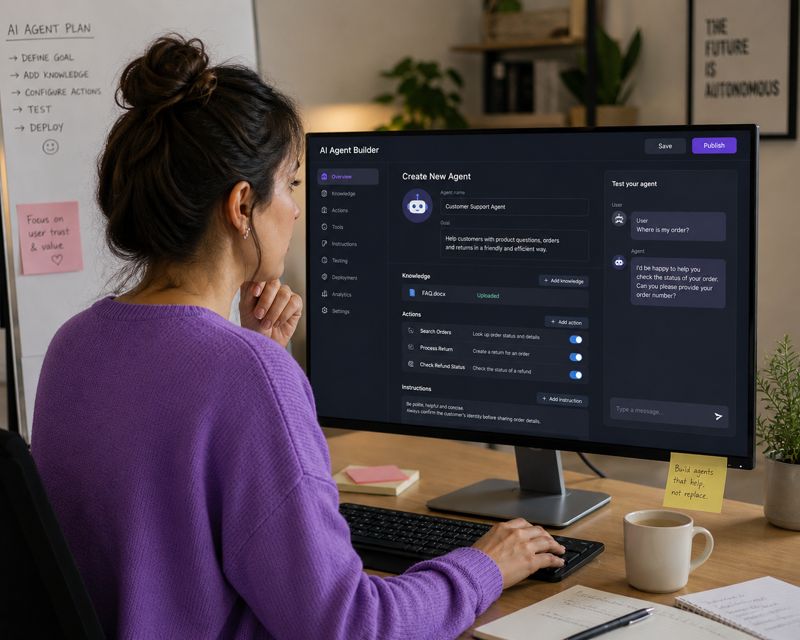
Think of it this way. You know how a regular computer program does exactly what you tell it: nothing more, nothing less? An AI agent is different. It can take a goal you give it, figure out the steps needed to get there, and actually do those steps on its own.
It’s less like a calculator and more like a very capable intern who never sleeps, never complains, and doesn’t need health insurance. AI Agents are built to help you automate tasks and save time.
A simple example: instead of you manually pulling together a list of donors who haven’t given in 18 months and drafting individual follow-up emails, an AI agent can identify those donors, craft personalized messages based on their giving history, and send them, all without you lifting a finger. It can even do this as you sleep.
That’s not automation. That’s judgment. And that’s a new tool that you can leverage. An AI Agent can help your entire team work more efficiently and deliver the reports to keep you on track.
What’s Actually Available Right Now
The good news: this isn’t vaporware. These tools exist today, and several are already built with nonprofits in mind. AI Agents aren´t meant to totally replace a team member, but they can dramatically reduce time spent on repetitive tasks and reporting.
The big players, Salesforce and Microsoft, both have AI agent products aimed at the nonprofit sector. Salesforce’s Agentforce for Nonprofits, for example, is designed to streamline mission operations, enhance donor engagement, and optimize program management. These are powerful platforms, but they’re also built for larger organizations with dedicated IT staff and bigger implementation budgets. Worth knowing about, but probably not affordable to a nonprofit with little operating budget.
What’s more interesting for small to mid-sized nonprofits is what’s happening at the more accessible end of the market.
Anthropic (the company behind Claude) now offers nonprofits up to 75% off, with built-in connectors to tools like monday.com, Blackbaud and Candid, platforms many nonprofits already use for donor management and grant research. Personally, I use Claude co-work in my day-to-day, and it saves me at least 15 hours a week! There is a free academy where you can begin or continue your AI learning specifically for nonprofits. Learn more about the free training AI Fluency for Nonprofits.
But here’s the one worth putting a pin in: monday.com’s CRM for nonprofits.
Unlike the enterprise tools that require months of implementation and a consultant, monday.com’s CRM is completely free for up to 10 users and built to be up and running fast. The AI agents can be built right on top of platform and can help your team automate follow-ups, track donor relationships, manage grant pipelines, and flag items that need attention before things fall through the cracks. It’s the kind of tool that works with your team, not around it.
Update: I just attended monday.com´s three-day agent-building workshop and learned that you can also find new grants and funding with their new AI capabilities! It is a place to truly run your nonprofit from A to Z. Get your free account today.
How to Get Started with AI Agents for your Nonprofit Work
Let’s make this concrete. Here’s where nonprofits are actually putting AI agents to work right now:
Grant Discovery and tracking. Staying on top of deadlines, reporting requirements, and funder relationships is a full-time job. AI can monitor your pipeline and send reminders before things go sideways. Not only is AI managing current grants, but it is also helping to scrape 990 data and new signals to help you discover new funders and get funding faster than ever before. An AI agent can run new searches for funding and new grants regularly to save your nonprofit months of research!
Donor follow-up. Rather than sending the same thank-you to every donor, an AI agent can analyze a donor’s giving history and engagement level to craft a personalized message, and even decide whether to suggest a monthly giving program or simply express gratitude.
Volunteer coordination. Answering the same five questions over and over from new volunteers? AI agents can respond to constituents in real time, help volunteers find the resources they need quickly, and free up staff to focus on higher-value work. You can also use AI to put together training resources for the volunteers and automate onboarding.
Program reporting. Pulling impact data together for your board or a funder used to take days. AI can do a first draft in minutes. This can all be done with your brand guidelines as well. Or the templates that you have been historically using. Repurpose this content into social media posts and let your agent create your next 10 posts as well as content strategy.
It all starts with data cleanliness
None of this works if your data is a mess. AI agents are only as good as what they have to work with. If your donor records live in three different spreadsheets, your volunteer list is in someone’s personal Gmail, and your grant history is in a binder on a shelf, an AI agent can’t help you yet. Start to clean and centralize your data so you can fully benefit from these powerful AI tools.
This is actually the most important insight in this whole article: before you can benefit from AI, you need your information in one organized place.
That’s not a criticism. It’s just the sequence. And it’s exactly why the first conversation most nonprofits should have isn’t about AI at all, it’s about getting their CRM right. Once your donor relationships, program data, and communications are centralized and clean, the AI layer can do its magic!
You Don’t Have to Be Big to Benefit from AI Agents
The narrative that AI is only for well-resourced organizations is getting less true by the month. Large nonprofits with budgets over $10 million have a 47% AI adoption rate, while mid-size organizations sit at 26% which means if you start now, you’re ahead of most of your peers, not behind.
You don’t need to overhaul everything. Start with one workflow that’s eating your team alive. See what becomes possible. Get a little of your time back so you can spend it on the work that actually matters.
One last thing, AI is going to reshape how nonprofits operate, and that can be a truly good thing. But it should never replace your people or be used without a clear purpose. If you’re thinking about bringing in agents or any AI tools, start small, have a plan, and keep humans in the loop. AI needs to be implemented safely and with the right governance. This technology works best when it’s backing up your team, not running ahead of it.