by Dylan Bassett,
Stop missing out on recurring donations and lifetime supporters when you already pay for the tool that can maximize fundraising
You have a CRM. Your team isn’t really using it to its best capabilities. Donor follow-ups still fall through the cracks. Program inquiries go cold. Partner opportunities get missed. Every month, someone spends hours pulling together a report that should just exist.
Sound familiar?
The instinct is to blame the tool or the team. But most of the time, neither is the real problem. The problem is that nobody has defined what should happen next at each point in the relationship. And without that, no donor or program management tool can help. It just stores contacts and waits.
The fix isn’t a new platform. It’s a clear answer to one question: what happens after a donor or client enters your system?
Your donors are moving through stages, whether you’ve defined them or not
Every donor relationship has a natural arc. Someone gets identified as a prospect. You reach out. They respond or they don’t. A conversation happens. An ask gets made. A gift comes in or it doesn’t.
Every program inquiry follows a similar pattern. Someone submits a request. Someone reviews it. They either move forward or they don’t. If they move forward, someone needs to hand them off to the right person.
What separates organizations that follow through from organizations that are stuck isn’t effort or intention. It’s whether the system knows what to do next and surfaces it automatically, or whether it’s waiting for someone to remember.
When you define the stages explicitly and tie the right actions to each one, your CRM stops being a contact database and starts being a coordination system. Staff know what’s in their queue. Nothing sits unassigned. Leadership can see where things stand without asking.
What this looks like for donor outreach
Picture a development team working from a prospect list. They have names, contact information, and some sense of giving capacity. What they don’t have is a system for what happens after the first email goes out.
Without defined stages, here’s what usually happens: someone sends an initial outreach, someone else makes a call, a follow-up lands on a to-do list that nobody checks, and three weeks later the prospect has heard nothing or has heard from three different people with no record of what was said.
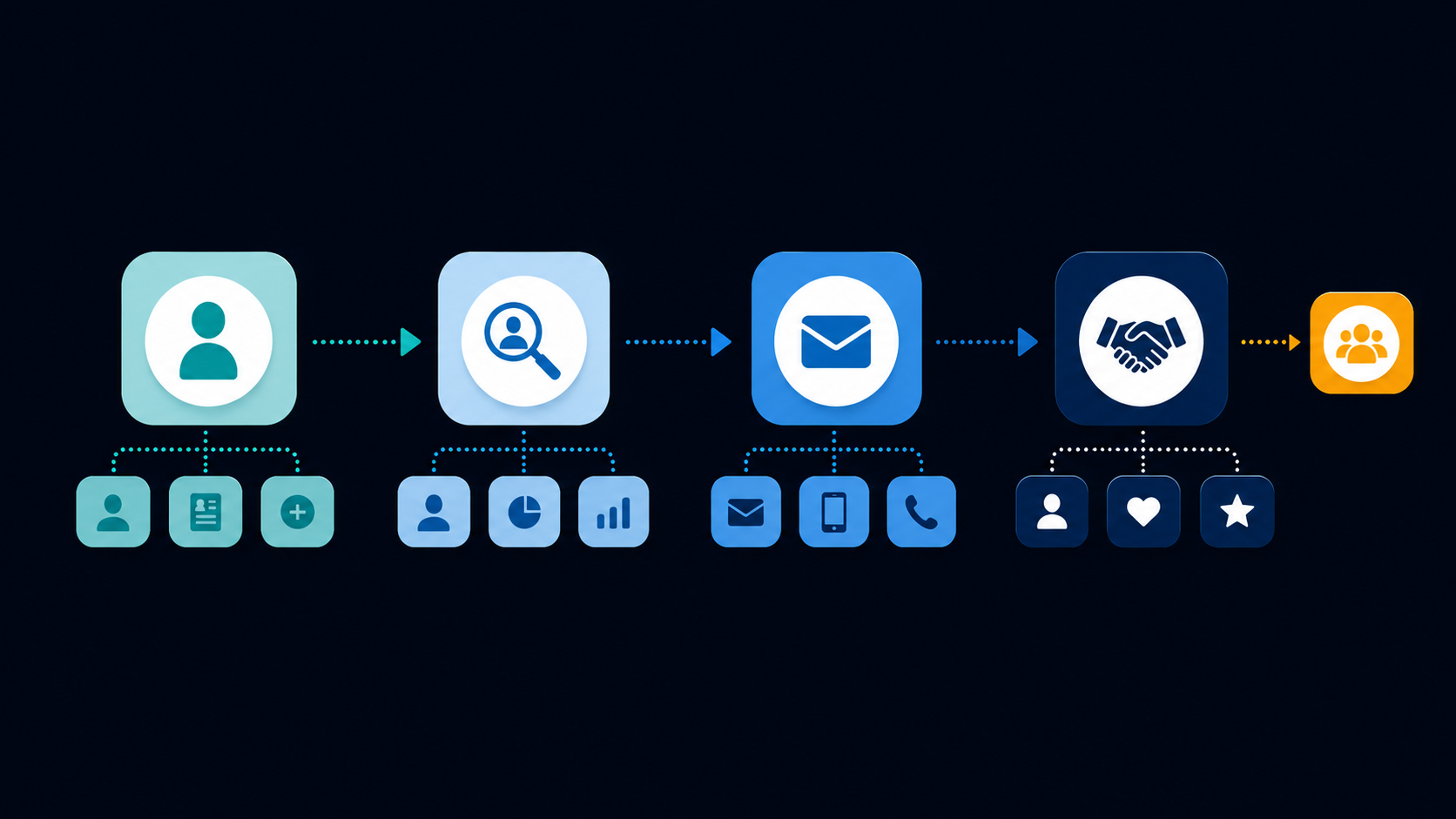
Here’s what a defined process looks like instead:
Before outreach begins, prospects get reviewed and assigned. High-capacity donors get flagged for a closer look before anyone picks up the phone. The coordinator sees exactly who is ready to work and who is waiting.
During enrichment and assignment, contact records get filled in and each prospect gets assigned to the right person. Different donors warrant different callers based on relationship fit that decision stays human.
During the outreach sequence, the system takes over the logistics. A defined cadence of calls, voicemails, and follow-up emails runs automatically at set intervals. Every team member can see what’s already been said to any prospect, so no one doubles up and no one goes dark.
At the close, automation steps back entirely. The conversation, the ask, the relationship that’s human work. The system’s job is to make sure nothing fell through before you got there.
One development team that built this kind of structure closed their first major gift through the pipeline shortly after launch. More importantly, the question of who was following up with whom and what had already been said stopped being a question at all.
For a step-by-step look at how this system was built in the free-for-nonprofits donor management platform monday.com including the full stage framework and automation logic, read a detailed breakdown here.
What this looks like for program intake
The same idea applies to how you manage people coming into your programs, and the stakes are often higher. A dropped handoff doesn’t just lose a potential donor. It means a person who needed help didn’t get it.
Consider a service organization managing client requests across multiple programs. Before their intake process was rebuilt, every submission landed in a spreadsheet. A staff member manually transferred it into their CRM. Someone reviewed it, sent a follow-up by hand, and tracked the rest of the process through memory and email threads. Monthly funder reports took hours to assemble because nobody had been logging activity consistently.
Here’s what a defined intake process looks like instead:
At intake, client submissions enter the system directly, no spreadsheet, no manual re-entry. The right record gets created automatically, and staff see the request in their queue immediately.
During triage and eligibility review, the process guides staff through a defined sequence rather than leaving it to judgment and memory. Escalations get documented. Follow-up reminders surface automatically if a request goes more than a week without action.
At conversion, required information gets enforced before the handoff. The staff member receiving the case always has everything they need to get started.
In reporting, the biggest change shows up last. Because every intake action and case engagement flows through the same structured system, the monthly program report becomes a dashboard refresh not a three-hour collation exercise.
For a step-by-step look at how my company, Dept.1 Solutions, helped a nonprofit serve more people with greater accuracy, read the guide on How to Build a Program Intake Pipeline in Salesforce.
Where most organizations go wrong
The most common mistake is trying to automate before defining the process.
Teams add workflows on top of contact records that aren’t clean, stages that haven’t been agreed on, and handoff logic that nobody has actually thought through. Things break quickly. Staff stop trusting the system. The CRM goes back to being a contact database.
The right order is simpler than it sounds:
First, pick one relationship donor outreach or program intake, whichever feels most broken right now.
Then answer three questions: What does a complete record look like? What has to happen before someone moves to the next stage? Who owns each step?
If you can answer those questions clearly, you have everything you need to build a system that works. The software is just the place you put it.
Where to start
You don’t need to redesign everything at once. Start with the one relationship type where dropped handoffs are costing you the most in missed gifts, in program participants who didn’t get served, or in staff time spent tracking things down.
Map out the stages. Define what happens at each one. Then build or configure your CRM to reflect that rather than hoping the CRM figures it out on its own.
That’s the difference between converting your CRM into a true management system that helps your team effectively run programs and fundraise by following through, as opposed to one that just accumulates names.
About the Author:
This article was written by Dylan Bassett, Principal of Dept.1 Solutions, a consulting practice specializing in scaling nonprofit relationship development across donors, partners, and programs with systems that don’t rely on staff memory. Based in Minneapolis, Minnesota, Dept.1 helps nonprofits build the operational systems that scale mission-driven work. Learn more at dept1solutions.com or reach out directly at [email protected].